Notre-Dame Cathedral
Place Jean-Paul-II, Ile de la Cité, 75004 Paris
Website – Tel: 01 42 34 56 10.
Metro station: Cité
Open daily: Monday to Friday: 7:50 a.m. to 7 p.m., until 10 p.m. on Thursay; Saturday and Sunday: 8:15 a.m. to 7:30 p.m.
Audio guides (fee) and guided tours (free) available. You can download the visit application from the Apple Store or Google Play.
Organized tours are based on its architecture, stained glass, sculptures, history and its ever-present prestige despite the fire that ravaged it on 15 April 2019.
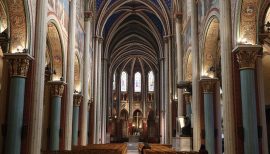
Famous worldwide, the Notre Dame Cathedral is a masterpiece of Gothic art. Its architectural cohesion leaves no trace that it was built, enlarged and restored for nearly eight centuries from the 12th to the 19th century, when the last major restoration was undertaken by Viollet-le-Duc. You could almost trace the history of Paris through the cathedral. It was present for some of French history’s greatest events, from Saint Louis’ crown of thorns in 1239 to Napoleon’s coronation in 1804 to the celebration of the Liberation in 1944. It even survived its fire on April 15, 2019.
History
The construction of the cathedral was led by Maurice de Sully, bishop of Paris in the 12th century, a project designed to build his capital a cathedral worthy of its place on the site of a Merovingian cathedral. The monumental construction site required the involvement of many actors: the church, the elders and the people of Paris. All participated in this great adventure based on their resources (some with money, others with labor). During the construction, all guilds (cutters, sculptors, carpenters, masons, glassmakers) worked tirelessly under the management of experienced architects, and with the help of the population who provided manual labor. Begun in 1163, the work would be initially completed over a century later.
Though it is full of artistic treasures, visitors today focus in particular on two rosettes (or roses), 13 meters in diameter. Following the fire in 2019, almost 21 hectares of oak trees (around 2,000) were needed to repair the structure.
Beyond the artistic beauty it exudes, it was indeed a considerable technical challenge. How would it be possible to hold roof that heavy on walls as high and open with windows and rosettes? The architects rose to this challenge by innovating; instead of basing the structure on the walls, they supported it on pillars. The cross-ribbed vaults inside and buttresses outside allowed for the distribution of the mass on all the pillars. The result is clear: the roof rises 33 meters high, the towers 69 to meters and the spire to 90 meters! Its unusual proportions make it the largest religious building in Europe. It served as an example for many other cathedrals, including the cathedrals of Amiens and Reims (listed as World Heritage sites), both built in the 13th century.
In the 13th century, architectural styles changed with the emergence of High Gothic, multiplying openings to promote the entry of light into the building.
As for many other monuments, the events of the Revolution damaged the statuary. In the mid-19th century Viollet-le-Duc recreated the carved decorations from old documents, or based them on works achieved in the cathedrals of northern France, contemporaries of the Notre Dame Cathedral. Today it remains the seat of the Archbishop of Paris.
Want to save time? Book your cathedral tours in advance
The story… of the rescue of Notre-Dame
The fire at Notre-Dame de Paris, which occurred on 15 April 2019, is believed to have been caused by an accident linked to the renovation work then underway on the roof. Although no criminal cause has been identified, investigations have put forward two main hypotheses: an electrical short-circuit, possibly in the site lift, or human negligence, such as a poorly extinguished cigarette. The fire started in the wooden framework, nicknamed the ‘forest’ because of its hundreds of old beams, and quickly spread to the entire roof, causing the central spire to collapse.
The rebirth of Notre-Dame
The reopening of Notre-Dame de Paris on 7 December 2024 marked the completion of a titanic project begun after the devastating fire on 15 April 2019. Here is an overview of the key stages in this reconstruction:
Stages of the reconstruction
1. Securing the site (2019-2021): After the fire, the first few years were devoted to securing the building, including removing damaged scaffolding and treating lead contamination.
2. Restoration of the structure (2021-2024): The work involved rebuilding the spire according to the original plans, restoring the vaults and walls, and refurbishing interior features such as the organ and bells.
3. Renovation of artistic elements (2023-2024): Stained glass windows, sculptures and other works of art have been restored or replaced, using traditional techniques and incorporating modern technologies to ensure their longevity.
4. Reopening to the public (December 2024): After five years of work, the cathedral reopened its doors, welcoming both the faithful and visitors from all over the world.
The restoration in figures
– Total cost: Around €700 million, financed entirely by private donations from over 340,000 donors in 150 countries.
– Workforce: Around 2,000 people, including 1,000 specialised craftsmen (carpenters, stonemasons, sculptors, etc.), contributed to the work.
– Materials used: Nearly 2,000 oak trees were felled to rebuild the roof structure, and 600 tonnes of scaffolding were erected to support the spire.
– Works restored: The cathedral’s 8,000-pipe organ was completely dismantled, cleaned and reassembled.
This ambitious project has not only restored a national symbol, it has also strengthened the bonds between citizens from all over the world, united by their support for the preservation of this exceptional heritage.
The towers of the Notre Dame Cathedral
Place Jean-Paul II, 75004 Paris
Access to the Towers Circuit is on the right when facing the Cathedral.
Website – Tel: 01 53 40 60 80.
Admission: €16. Free for EU citizens under 26, and for non-EU visitors under 18. Free for everyone on the first Sunday of January, February, March, November, and December.
Open daily. Last entry one hour before closing.
April to September: 9 a.m. to 6:30 p.m. Night openings in July and August on Fridays and Saturdays until 11 p.m.
October to March: 9 a.m.to 5:30 p.m.
Classified as a National Monument.
In case of adverse weather conditions, the Notre-Dame Towers circuit may be exceptionally closed. In the event of such closure, e-tickets purchased via the National Monuments Centre’s online ticketing service are automatically refunded to the debited bank account. No action is required from the visitor.
Access conditions: entry is only permitted with an e-ticket. Booking a time slot is mandatory, including for visitors entitled to free admission.
Visiting conditions: climbing to the top of the South Tower is a physical experience requiring good fitness. The circuit is strongly discouraged for visitors with heart conditions and/or vertigo, pregnant women, and young children.
The route includes 424 steps and rises 69 meters. Some passages are narrow (45 cm) and low (requiring visitors to stoop).
Discover the tour with Le compagnon des tours, the monument’s webapp that guides you through the circuit. The app is only available on smartphones and is translated into 12 languages.
Tour itinerary:
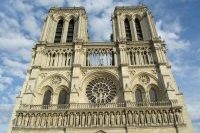
- The lower hall of the South Tower: its vaulted ceiling reaches 14 meters high.
- The Quadrilobes Room is named after the shape of its openings. A massive oak structure rises here: the belfry, featuring a magnificent double-helix wooden staircase.
- The top of the South Tower offers a superb view of the roof and spire. Since the fire, the rooster atop the spire has been replaced by a phoenix, symbolizing resurrection.
- The South Tower’s great bells: Marie and Emmanuel. The latter, cast over 300 years ago, was named Emmanuel by Louis XIV and weighs 13 tons. These great bells ring only on special occasions.
- The Cisterns Courtyard recalls the former water reserves once stored here for fire prevention. The Gallery of Chimeras owes its name to the statues adorning the balustrade. The most famous, the Stryge (half-woman, half-bird), appears to contemplate the city’s transformations. The sculpted decoration visible from the gallery is remarkably detailed.
- The North Tower also houses a belfry with eight smaller bells, which chime daily for the hours and cathedral services.
The Exterior of the Cathedral
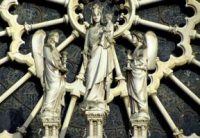
The outside court, installed by Haussmann, is the symbolic heart of Paris. All French road distances are measured from this point.
The Façade of the Cathedral
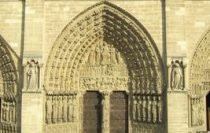
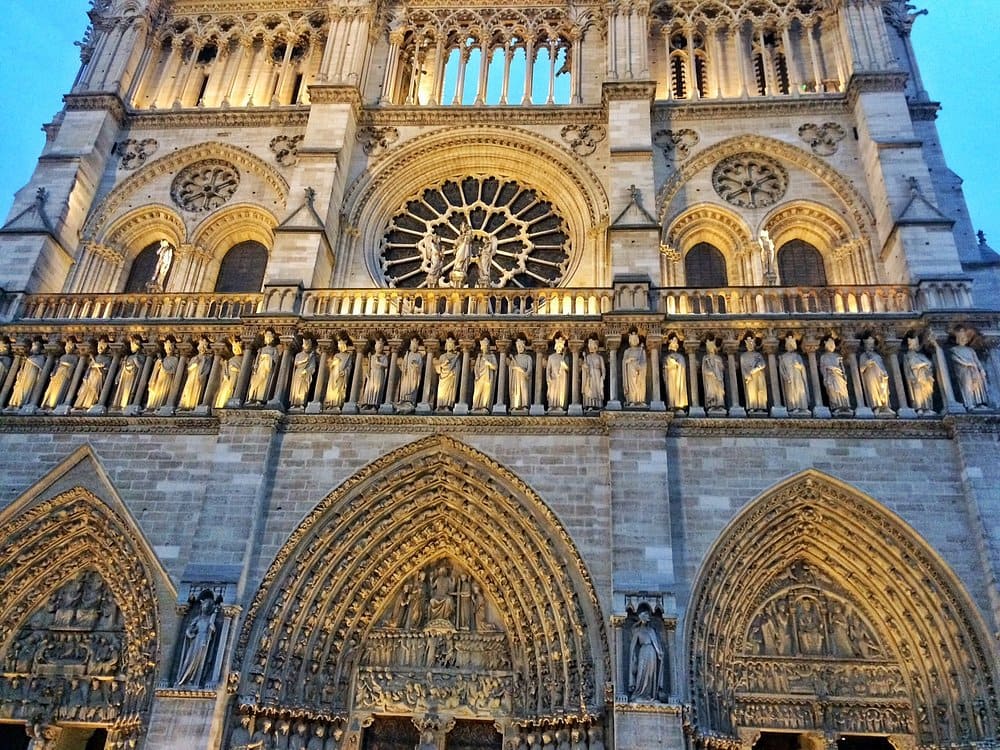
The front of the cathedral is simply dazzling: its size, continuity and sculptures represent an exceptional masterpiece. The three portals are entirely decorated with statues recounting the Bible and the lives of Saints: 28 statues representing the kings of Judah and Israel, the ancestors of Christ. Above these characters, on either side of the facade, are statues of Adam and Eve. In the center, there is a statue of the Virgin and Child flanked by two angels. On the left, the Portal of the Virgin presents images of the Coronation of the Virgin. In the center, the portal of the Last Judgement is Christ judging the dead. The Sainte-Anne portal on the right shows Madonna and Child.
The Portal of the Virgin (to the left)
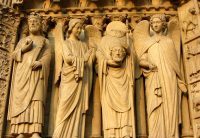
Depicted are the prophets who announced the Virgin’s glorious destiny and kings from which they descend. Above, the Virgin Mary is shown in her last sleep, presided over by Christ and the apostles. Even further above, an angel crowns Mary while Christ, seated on the same throne as his mother, hands her a scepter: Mary becomes Queen of Heaven. Saint Denis can be seen carrying his head in his hands ; evangelizer of the Gauls and the first bishop of Paris, he was beheaded around 250 AD. In front of him, the patron and protector of Paris, Sainte Genevieve, holds a candle that a little devil tries to extinguish.
The Portal of the Last Judgment (in the center)
Jesus is depicted as the one who welcomes us to Heaven, while Mary and Saint John pray. At the bottom is the Resurrection, while in the middle we see the weighing of souls: elected officials are taken to Heaven by angels, others are taken to hell by demons. Christ is surrounded by the twelve apostles.
The Saint Anne Portal
This portal is dedicated to Mary’s mother. Holding the baby Jesus, Mary is surrounded by angels bearing censers, a bishop (perhaps Sully) and a king (perhaps Louis VII). The sculptures narrate episodes from the life of Mary: the Annunciation, the Visitation, the Nativity, the Adoration of the Magi. The grandparents of Jesus, Saint Anne and Saint Joachim, can also be seen.
Saint Etienne Portal
Located on the south side of the cathedral, the carvings on this portal tell the story of the saint’s life. At the top, Jesus blesses Saint Etienne and welcomes him to Heaven. The medallions on the sides narrate scenes of student life in Paris in the Middle Ages.
The Cloister Portal
The sculptures of this portal depict episodes from the life of Mary: the birth of Jesus and the manger, the offering to the temple of Jerusalem, the persecution of children by King Herod and his flight, and Joseph’s escape to Egypt to protect their son.
Gargoyles and Chimera

Implemented at the end of the gutters to drain rainwater from the roof, the gargoyles of Notre Dame are very famous (see box “The Story of a Novel”). The chimeras, also numerous, are simply decorative. They are particularly numerous on the front of the cathedral, as if they are watching the passers-by and admiring Paris. These creatures, drawn with great imagination by Viollet-le-Duc, are fantastic birds, hybrid animals or monsters perched on the towers.
The Interior of the Cathedral
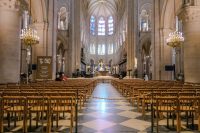
The Wall of the Chancel
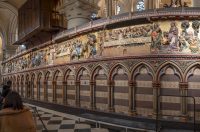
The Wall of the Chancel is decorated with carvings depicting the life of Christ: the north side recounts his childhood, and the south side shows his resurrection. The missing stages of this work were destroyed.
The Rosettes
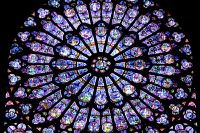
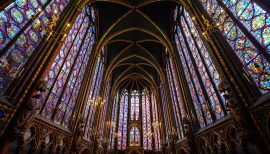
The Notre Dame Cathedral has three monumental rosettes. Made in the 13th century, they represent a masterpiece of technical and artistic work. The two largest are each 13 meters in diameter. It is said that to see its completion, the king Saint Louis delayed his departure a few months for the second crusade (in 1270), should he not return. They represent the flowers of Heaven. Two rosettes show the Virgin and Child, the third smaller one, Christ in Majesty. Colorful medallions surround the rosettes with a variety of characters and scenes (Prophets, Saints, Angels, Kings, field laborers, etc.).
The Organ
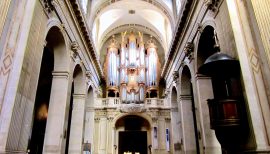
The organ in place today dates back to the 18th century. Restored in 1868 by Aristide Cavaillé-Coll under the authority of Viollet Le Duc, it finds a symphonic fullness with 86 sounding registers, 5 manuals and pedals. It is now considered the largest in the country.
The Treasury
Full price / reduced price: €12 / €6
Open from Monday through Saturday: 9:30 a.m. to 6 p.m., until 9 p.m. on Thursday, Sunday: 1 p.m. to 5:30 p.m.
See box “The Story of the Holy Relics” of the Sainte-Chapelle.
The Story of… a Novel
The famous novel by Victor Hugo, Notre-Dame de Paris, published in 1831, tells a historic story rendered gripping by the imagination of the novelist. The novel reconstructs medieval life around the cathedral in the 15th century. An important part of the action takes place in the towers, and a prominent place is given to the bells and their famous bell ringer, Quasimodo. Defender of French heritage, Victor Hugo actively participated in the important campaign that led to the restoration of Notre Dame in 1845.