
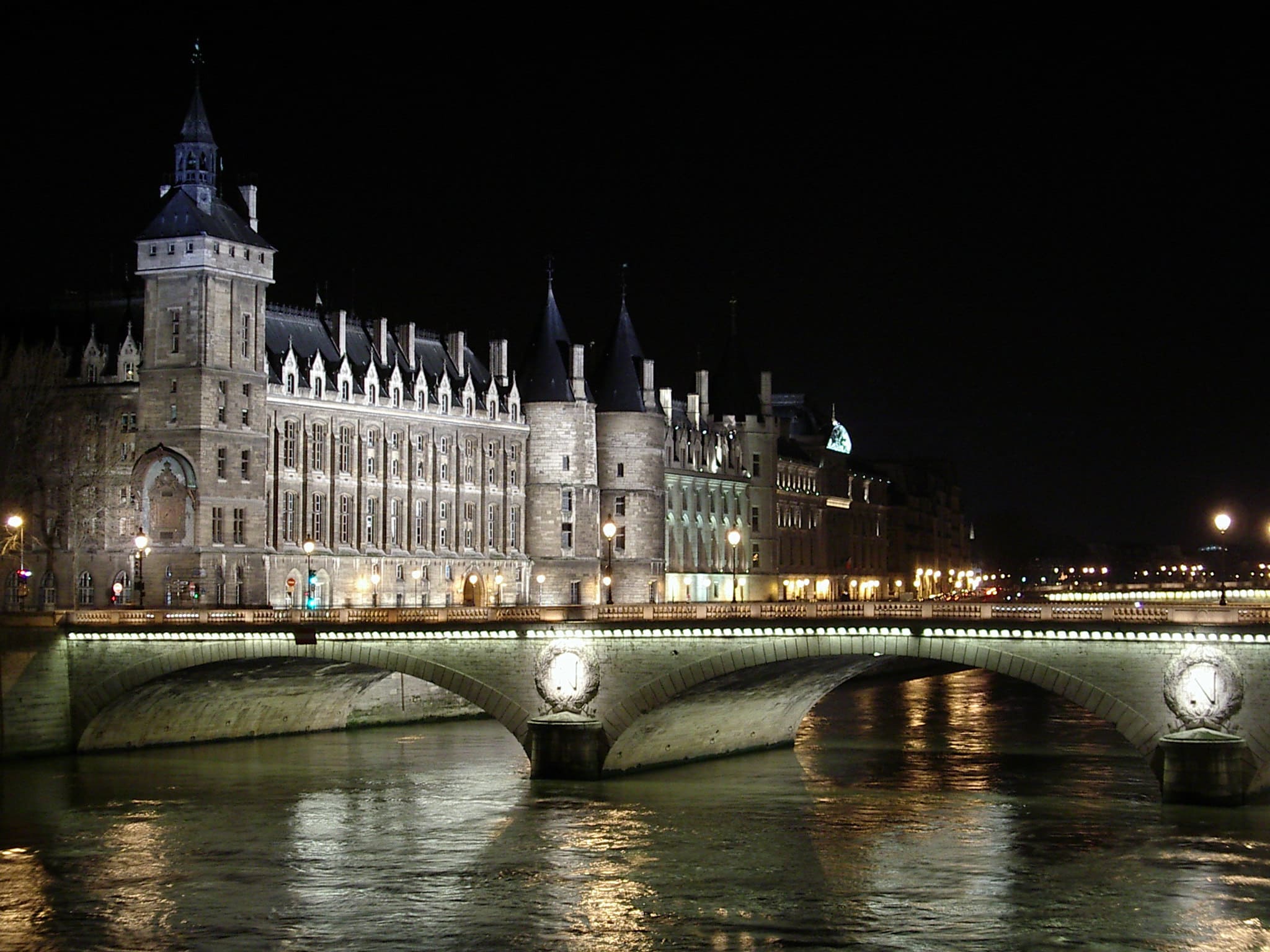
La Conciergerie (1248)
2 Boulevard du Palais, Ile de la Cité, 75001 Paris
Website – tel : 01 53 40 60 80.
Metro station : Cité
Price : €13. Free for EU citizens under 26 years old (free for non-EU citizens under 18 years old).
Combination pass for the Conciergerie and Sainte-Chapelle, price from: €23.
Open daily : 9:30 a.m. to 6 p.m.
Guided tour organized daily. No extra charge on the ticket price.
Visit with HistoPad (augmented reality, 3D reconstruction, interactive features) in 6 languages. Visits and workshops for children organized all year round.
Classified as a National Monument.
The HistoPad Experience: I highly recommend picking up the HistoPad at the entrance; this augmented reality tablet allows you to see the medieval halls exactly as they appeared during the French Revolution, making the history of Marie Antoinette’s final days truly immersive.
Residence of the kings of France and symbol of royal power
In the 13th and 14th centuries, Saint Louis and his grandson Philip IV contributed to the building of a prestigious palace that became the symbol of the monarchy’s power.
At the end of the 14th century, Charles V left the royal residence of the city. He chose to live in a better-protected place: at the Hôtel Saint-Pol (now defunct).
A concierge, important figure of the court with powers of justice, administered the operations of the palace and the prison.
The Conciergerie was a prison until the 19th century: Ravaillac (Henri IV’s assassin), the bandit Cartouche, Marie Antoinette, Robespierre and many others spent their last days inside its walls.
Daily life at the prison
The Conciergerie was known as the toughest prison of its time. During the Terror (1793), the cells held several hundred prisoners, housed in unsanitary and overcrowded conditions. Once a prisoner’s death sentence verdict was decided, he or she was allowed a final banquet meal.
My Tip: To see the medieval highlights, this is the experience I suggest.
The medieval halls
The lower parts, the only sections remaining today, were reserved for the royal guard and the many people in the service of the king (about 2,000 people).
The Weaponry Hall, built under Philip IV, is a unique European example of civil Gothic architecture. Four fireplaces warmed the vast refectory.
The pavilion kitchens (14th century), of which only the ground floor remains, were used to serve meals to the palace staff. Located near the Seine, the goods arrived by river.
The guard room served as an antechamber to the king’s apartments located upstairs. The Revolutionary Tribunal, which ordered dozens of daily executions, sat there from 1793 to its dissolution in 1795.
The prisoners’ corridor allowed inmates to move about “freely”. A series of dungeons shows the different categories of prisoners.
The Girondins’ Chapel. In memory of the 21 Girondin representatives who feasted there before their execution on October 30, 1793.
The Memorial Chapel of Marie Antoinette was appointed in 1815 on the site of the cell where the queen awaited her execution.
The women’s court, surrounded by two floors of dungeons prisoners, still has the fountain where they washed their clothes, stone tables where they took meals and “the corner of the twelve.” It was here that the prisoners, in groups of 12, awaited the wagon that would take them to the scaffold.